For many parents, the question of school board becomes much more serious once their child begins showing an interest in engineering or medicine. At that stage, conversations often move beyond regular school performance and start focusing on competitive examinations such as JEE and NEET. One of the most common concerns among parents is whether an ICSE education will put their child at a disadvantage when preparing for these examinations. It is not unusual to hear advice such as, “If your child wants to prepare for JEE or NEET, move to CBSE after Class 10.”
The reality, however, is more nuanced.
Students from ICSE and ISC backgrounds qualify for JEE and NEET every year. The board a child studies under can influence the style of learning and the resources they are exposed to, but it does not determine whether they can succeed in a competitive examination.
A more useful question for parents is whether their child is receiving the conceptual foundation, academic discipline, guidance and examination-specific preparation required to perform well. For families comparing ICSE schools in Kanpur, particularly those thinking ahead to engineering or medical entrance examinations, understanding this difference is important.
Understanding the Difference Between ICSE and ISC
Before comparing ICSE with CBSE for competitive examinations, it is worth clearing up one common misunderstanding.
The term “ICSE student” is often used informally to describe a child studying throughout the CISCE system. Technically, however, ICSE refers to the Class X examination conducted by the Council for the Indian School Certificate Examinations. Students who continue within the same educational system in Classes XI and XII generally study under the ISC curriculum.
This distinction matters because JEE and NEET are typically attempted after senior secondary education. Therefore, when parents search for questions such as “Is ICSE good for JEE?”, “Is ICSE good for NEET?” or “Can ICSE students crack JEE?”, what they are usually asking is whether continuing within the CISCE academic pathway will affect their child’s competitive-exam prospects.
It does not prevent them from succeeding. What matters much more is how effectively the student combines school education with the requirements of the entrance examination.
Can ICSE Students Successfully Prepare for JEE?
Yes. Students from ICSE and ISC backgrounds can and do qualify for JEE Main and JEE Advanced. A strong ICSE education often gives students a detailed understanding of subjects, particularly when the school encourages conceptual learning rather than simple memorisation. This can be valuable for JEE, where Mathematics, Physics and Chemistry questions often require students to apply concepts in unfamiliar situations.
However, strong school academics alone are not enough. JEE preparation has its own demands. Students need to become comfortable with objective problem-solving, multiple concepts within a single question, speed, accuracy and disciplined time management. They also need regular exposure to NCERT concepts, previous-year examination questions, timed practice and mock tests.
This means that an ICSE student preparing for JEE should not treat school study and competitive preparation as two unrelated activities. The most effective approach is to use school learning to build conceptual strength and then develop examination-specific skills through structured practice. For example, when a Physics concept is introduced in school, the student should eventually learn how that same concept appears in JEE-style numerical and application-based questions. The academic foundation remains the same, while the form of application becomes more demanding.
Is ICSE Suitable for NEET Preparation?
The answer is again yes, but students need to understand how NEET preparation differs from regular school assessment. NEET places considerable emphasis on Biology, Chemistry and Physics, with NCERT material playing an especially important role. Students from an ICSE background may already be comfortable studying subjects in detail, but competitive preparation requires them to align closely with the actual examination syllabus and question pattern.
Biology is a good example. A student may have studied a topic in greater descriptive depth in school, but NEET preparation requires extremely close familiarity with NCERT terminology, diagrams and factual information. The student therefore needs to make NCERT a central part of revision rather than assuming that school textbooks alone will be sufficient.
Physics requires a strong understanding of concepts alongside repeated numerical practice, while Chemistry demands a combination of conceptual understanding, application and accurate recall. For this reason, the board itself should not be viewed as a barrier. What matters is whether the student’s study plan includes the resources and practice required by the entrance examination.
Why Do Many Parents Believe CBSE Is Better for JEE and NEET?
The belief is understandable.
CBSE students generally work more directly with NCERT textbooks during their regular school years, while NCERT resources are extremely relevant to national-level competitive examinations. This can reduce the amount of adjustment required when students begin entrance-focused preparation.
However, familiarity with NCERT is only one part of the equation. A student still needs conceptual clarity, problem-solving ability, revision discipline, examination temperament and thousands of carefully selected practice questions before becoming genuinely competitive in JEE or NEET.
Simply studying in a CBSE school does not guarantee success. Similarly, studying in an ICSE school does not automatically create a disadvantage. An ICSE student may need to intentionally incorporate NCERT material into the study routine, while simultaneously benefiting from the analytical and detailed subject understanding encouraged by a strong ICSE education.
ICSE vs CBSE for JEE: What Should Parents Actually Compare?
When evaluating ICSE vs CBSE for JEE, parents should move beyond the simple question of which syllabus appears closer to the entrance examination.
JEE tests much more than familiarity with a textbook. A student has to interpret difficult problems, identify relevant concepts, combine multiple principles, manage time and solve questions accurately under pressure. This means the quality of Mathematics and Science teaching matters enormously.
A child studying in an environment where teachers explain why a concept works, encourage questioning and expect students to solve unfamiliar problems may build a stronger base than a child who simply memorises examination patterns. At the same time, an ICSE or ISC student planning to appear for JEE should deliberately build familiarity with NCERT, competitive question banks and mock examinations. The strongest strategy is not to choose between conceptual depth and entrance-oriented preparation. It is to develop both.
ICSE vs CBSE for NEET: Where Is the Difference More Noticeable?
The comparison becomes slightly different for NEET because of the importance of NCERT, particularly in Biology. Students who are already working closely with NCERT material may find the transition into NEET preparation somewhat smoother. However, the difference can easily be managed by students from other boards if the preparation strategy is structured properly.
An ICSE student should begin integrating NCERT resources early enough to avoid having to completely reorganise the study approach near the examination. This does not mean abandoning school learning. In fact, a detailed understanding of Biology, Chemistry and Physics can become an advantage when combined with NCERT-focused revision and examination practice. The aim should be to develop both depth and precision.
Should an ICSE Student Move to CBSE After Class 10?
This is one of the most important decisions families make, and it should never be based only on what other parents are doing. Changing boards after Class 10 can work well for some students. For others, it can introduce unnecessary disruption.
A board change may also mean changing schools, teachers, classmates, teaching methods, assessment patterns and study routines at the beginning of Class XI, which is already one of the most academically demanding transitions in school education. Parents should therefore first assess whether there is a genuine academic reason for making the change.
If the student is receiving strong Science and Mathematics teaching, is comfortable in the current school environment, has access to the right preparation resources and is able to integrate NCERT with regular studies, changing boards may not provide the dramatic advantage families sometimes expect. On the other hand, if a different school environment would clearly provide better academic support, examination preparation or subject choices, then a change may be worth considering.
What Matters More Than the Board?
For a future JEE or NEET aspirant, the quality of the student’s academic environment matters far more than the label attached to the board. Conceptual clarity comes first. Competitive examinations regularly present familiar concepts in unfamiliar forms. A student who understands the underlying principle is far more likely to solve such questions successfully than one who has only memorised a formula.
The quality of Science and Mathematics teaching is equally important. Good teachers do more than complete a syllabus. They identify misconceptions, explain difficult concepts from different angles and encourage students to think independently. Laboratory exposure also has value. Physics, Chemistry and Biology become more meaningful when students have opportunities to observe, experiment and connect theory with actual phenomena.
Time management becomes increasingly important in Classes XI and XII. Students preparing for competitive examinations need to balance school assessments, revision, problem-solving and mock tests without creating an unsustainable routine. Finally, students need support. JEE and NEET preparation can become demanding, and there are periods when academic pressure, self-doubt and fatigue affect even strong students. A school environment where teachers and counsellors recognise these challenges can make a meaningful difference.
What Does Swaraj India Public School’s Record Show?
For parents looking for an ICSE school in Kanpur for JEE or NEET preparation, actual student outcomes provide more useful information than promotional claims. Swaraj India Public School has recorded multiple JEE and NEET qualifications across recent years.
According to the school’s published achievement records, three students qualified for NEET UG and three students qualified for IIT-JEE in 2025. In 2024, five students qualified for NEET UG while three students qualified for IIT-JEE. The 2023 record includes two NEET qualifiers and five IIT-JEE qualifiers. These results do not suggest that success happens automatically because of the school or the board.
How SIPS Supports Strong Academic Foundations
A competitive examination is ultimately taken after years of academic development. For that reason, the quality of the foundation built before Class XI matters considerably. At Swaraj India Public School, classroom learning is designed to extend beyond textbook memorisation. As students progress through the school, they are encouraged to research, analyse, discuss, debate and present ideas.
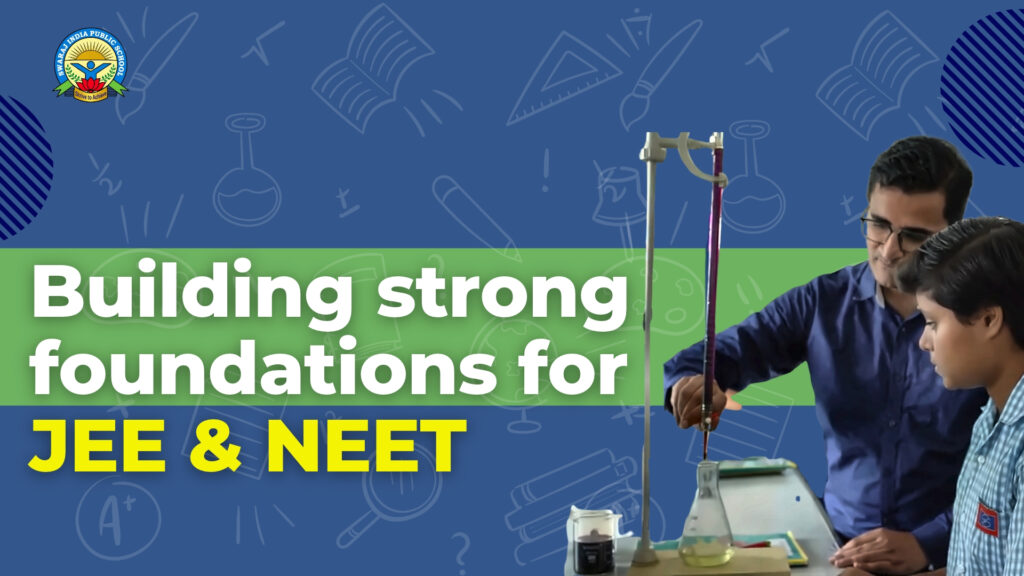
This develops habits that are valuable well beyond board examinations. The school also provides dedicated Physics, Chemistry, Biology and Computer Science laboratories, giving students opportunities to connect theoretical concepts with practical observation. Digital learning resources, library access and structured academic support further help students explore subjects more deeply. For a future JEE or NEET aspirant, these experiences can contribute to the kind of conceptual confidence that competitive preparation later requires.
Can a Student Balance JEE or NEET Preparation With School Life?
One of the biggest mistakes families can make is assuming that a serious competitive-exam aspirant must stop doing everything except studying. Preparation certainly requires discipline and prioritisation, but students also need routines they can sustain for months and years. Physical activity, social interaction and occasional participation in non-academic activities can help students maintain mental balance during demanding preparation periods.
The amount of time given to different activities may naturally reduce as examinations approach, but removing every other part of school life does not necessarily improve performance. Swaraj India Public School follows a broader educational model where academics, sports, student leadership, communication and counselling are treated as connected aspects of student development.
This approach is particularly relevant because competitive examinations are demanding not only intellectually but also emotionally. Students who can manage pressure, organise their time and recover from setbacks are often better equipped for long preparation cycles.
What If a Child Is Not Yet Sure About JEE or NEET?
Parents should be especially careful about designing a child’s entire school education around an entrance examination many years before the child is expected to take it. A student who talks about engineering in Class VI may later become interested in economics, law, architecture, design, research, entrepreneurship or another field altogether. A student who has never considered medicine may discover a strong interest in Biology several years later.
This is why broad education remains important. Strong communication, analytical ability, research skills, writing, problem-solving and independent learning are valuable regardless of whether a student eventually chooses IIT, medicine, law, management, research or another career. The goal in the early and middle school years should therefore be to develop a strong learner. Specific competitive-examination preparation can then be added at the appropriate stage.
When Should JEE or NEET Preparation Begin?
There is an important difference between building strong foundations early and beginning high-pressure entrance coaching too early. During the earlier school years, children benefit more from strengthening Mathematics, scientific curiosity, reading, reasoning and disciplined study habits. These abilities later make competitive-exam preparation easier.
As the student moves closer to Classes XI and XII, preparation can become increasingly examination-specific through NCERT revision, advanced problem-solving, mock tests and targeted entrance resources. Parents do not need to treat every academic decision made in Class V or VI as a direct JEE or NEET strategy. A child who learns to understand concepts deeply, read independently, ask good questions and work consistently is already developing many of the habits needed later.
What Should Kanpur Parents Look for in a School?
Parents who already know that engineering or medicine may be part of their child’s future should ask more detailed questions when visiting schools.
- Ask to see the laboratories.
- Instead of asking only about board results, enquire about the quality of Science and Mathematics teaching.
- Understand how students who struggle with particular concepts receive additional support.
- Ask about the transition from Class X into senior secondary classes.
- Find out whether students receive career and academic counselling.
- Look at previous JEE and NEET results, but do not treat the numbers in isolation. Ask how the broader academic environment supports those students.
- It is also worth understanding how the school approaches conceptual learning.
- A future engineering or medical aspirant benefits from an environment where students are encouraged to understand why something happens, not simply memorise the correct response.
For parents searching for the best ICSE school in Kanpur for JEE or NEET, this may be one of the most useful differences to evaluate.
So, Is ICSE Good for JEE and NEET?
Yes.
An ICSE education can provide a strong academic foundation for both JEE and NEET. Students may need to make NCERT a deliberate part of their competitive-examination preparation and become comfortable with objective, time-bound test formats, but neither requirement makes changing boards compulsory.
- The board is ultimately only one component of a much larger preparation system.
- A strong school foundation, consistent student effort, relevant examination resources, effective time management and appropriate guidance matter considerably more.
- For parents, the better question is therefore not whether ICSE is “good” or “bad” for JEE and NEET.
- The better question is whether the child’s school is building the knowledge, confidence and learning habits required to succeed when the time comes.
Considering an ICSE School in Kanpur?
Swaraj India Public School is a CISCE-affiliated K–12 school in Kakadeo, Kanpur. The school combines a structured academic environment with Science and Computer laboratories, student leadership, sports, counselling and opportunities for learning beyond regular classroom instruction. Its published achievement record includes multiple students qualifying for JEE and NEET across recent academic years.
Parents evaluating an ICSE school in Kanpur can explore the school’s academic approach, review student achievements and visit the campus before making an admission decision.
Swaraj India Public School
117/M/8, M-Block, Kakadeo
Kanpur – 208019
Phone: +91-512-2500309 / +91-512-2504442
Frequently Asked Questions
Can ICSE students crack JEE?
Yes. Students from ICSE and ISC backgrounds can successfully qualify for JEE Main and JEE Advanced. They need strong concepts in Mathematics, Physics and Chemistry along with regular exposure to NCERT, entrance-level problem-solving, mock tests and previous-year questions.
Is ICSE good for NEET preparation?
Yes. ICSE can provide a strong conceptual base for NEET. Students should, however, make NCERT an important part of their preparation, particularly for Biology, while also practising the actual NEET question format regularly.
Is CBSE better than ICSE for JEE?
CBSE students may have greater familiarity with NCERT during regular school study, which can make part of the transition easier. However, success in JEE depends far more on conceptual understanding, problem-solving ability, practice and consistency than on the board name alone.
Should an ICSE student switch to CBSE after Class 10 for JEE or NEET?
Not necessarily. Parents should first consider the quality of teaching, the student’s academic comfort, the availability of preparation resources and the disruption involved in changing schools or boards. A switch should solve a genuine academic need rather than simply follow a general assumption.
Can an ICSE student prepare for NEET using NCERT?
Yes. In fact, ICSE and ISC students preparing for NEET should deliberately include NCERT in their study plan because of its importance to the examination syllabus, particularly in Biology.
Does Swaraj India Public School have JEE and NEET qualifiers?
Yes. The school’s published achievement records include multiple students qualifying for IIT-JEE and NEET across recent years, including 2023, 2024 and 2025.
Which ICSE school in Kanpur should parents consider for a future JEE or NEET aspirant?
Parents should compare the quality of Science and Mathematics teaching, laboratories, academic results, previous competitive-exam outcomes, student support, counselling and overall learning environment. Swaraj India Public School in Kakadeo is one of the options families can evaluate using these criteria.
Does studying in ICSE disadvantage students in national competitive examinations?
No. Students may need to deliberately align parts of their preparation with NCERT and competitive-examination patterns, but a strong ICSE education can provide valuable conceptual depth. The student’s preparation strategy matters considerably more than the board alone.