
ICSE School Admission in Kanpur 2027–28: Process, Documents, Fees & Complete Parent Guide: Choosing a school is one of the few decisions parents make today that can influence almost every working day of a child’s life for several years.
A school affects much more than examination results. It shapes daily routine, friendships, communication, discipline, confidence, exposure, interests, academic habits and the way a child begins to understand responsibility.
That is why searching for ICSE school admission in Kanpur for the 2027–28 academic session should not begin and end with a list of school names.
Parents often start with Google searches such as:
- best ICSE school in Kanpur;
- ICSE school near me;
- ICSE school in Kakadeo;
- Class 1 admission in Kanpur;
- school admission in Kanpur 2027–28;
- ICSE school fees in Kanpur;
- or top school in Kanpur.
These searches are useful for discovery, but they cannot make the final decision for your family.
A school that works extremely well for one child may not be the right environment for another.
One student may need strong academic structure. Another may require additional confidence-building and counselling support. One family may place sports high on the list, while another may value language development, public speaking or a manageable daily commute.
The useful question is therefore not simply:
“Which is the best ICSE school in Kanpur?”
The better question is:
“Which ICSE school in Kanpur offers the right academic environment, teachers, culture, support and opportunities for my child?”
This guide has been created to help parents answer that question more carefully.
It covers the complete school-selection process from Class 1 onwards, including admission planning, documents, entrance interactions, school visits, academics, teaching quality, student support, sports, co-curricular exposure, fees, location, questions to ask and a practical comparison framework.
Parents considering Swaraj India Public School in Kakadeo, Kanpur will also find current school-specific information throughout the guide.
At the time this guide is being prepared, Swaraj India Public School’s official website is still displaying admission and fee information connected with the current 2026–27 cycle. Families planning for 2027–28 should therefore use this article as an early planning resource and confirm final dates, fee schedules, seat availability and admission requirements directly with the school once the new cycle is officially announced.
Quick 2027–28 Admission Planning Snapshot
Before going deeper, parents can use this table as an initial checklist.
| Admission Area | What Parents Should Check |
|---|---|
| Class availability | Confirm whether seats are available in the required class |
| Age criteria | Important especially for Class 1 and younger entry classes |
| Previous records | Latest report card may be required |
| Registration | Check official registration process and applicable charge |
| Documents | Birth certificate, photos, Aadhaar/report card where required |
| Interaction | Ask whether the child and parent must attend |
| Entrance assessment | Confirm class-specific process |
| Campus visit | Strongly recommended before finalising |
| Fees | Request complete class-wise fee schedule |
| Transport | Check actual daily travel time |
| Student support | Ask about remedial help, counselling and academic support |
| Activities | Understand actual participation rather than only available facilities |
| Parent communication | Ask how progress and concerns are shared |
This table should not be treated as a substitute for official school information. It is a framework to help parents ask better questions.
Why Parents Start School Research Early
School admission becomes easier when families begin with enough time to compare options instead of making a decision under pressure.
An early start allows parents to do three things well: research, visit and verify.
Research Before Shortlisting
The first stage is usually online.
Parents can study school websites, curriculum pages, admission information, campus details, achievements and parent communication channels.
This helps reduce a long list of schools to a manageable shortlist.
However, online research should be treated as the beginning of the process, not the final answer.
Every school naturally presents its strengths on its website. Parents should then verify how those strengths work in day-to-day school life.
Visit Before Deciding
The campus visit helps families understand what cannot be communicated fully through photographs or brochures.
You can observe:
- how staff speak to students;
- how organised the campus feels;
- whether students appear comfortable approaching teachers;
- whether activity spaces are actively used;
- and whether administrative staff answer questions transparently.
Verify Before Paying
Before completing admission, parents should reconfirm:
- the correct class;
- seat availability;
- applicable fees;
- transport options;
- academic session dates;
- documents;
- and any entrance or interaction process.
A written or official confirmation is always better than relying on informal information.
Why Consider an ICSE Learning Environment?
ICSE School Selection & Admission Readiness Tool
Planning ICSE school admission in Kanpur? Select your child’s class, rate what matters most to your family and complete a quick admission readiness check. The tool will create a personalised school-selection checklist and campus-visit plan.
1 Select the admission stage
2 What matters most when choosing a school?
Move each slider according to your family’s priorities. 1 = lower priority, 5 = very important.
3 Admission readiness check
Your strongest priorities
Admission readiness
Questions to ask during your school visit
Admission preparation checklist
How Swaraj India Public School fits into your shortlist
An online school-selection tool cannot decide which school is best for a child. Use the result to prepare better questions, then visit the campus and evaluate the school personally.
117/M/8 (M-Block), Kakadeo, Kanpur – 208019, Uttar Pradesh
Phone: +91-512-2500309 / +91-512-2504442
Email: info@sipsknp.com
How to use this ICSE school selection tool
Parents researching ICSE school admission in Kanpur often compare schools using rankings alone. A more useful approach is to identify what matters most for the individual child, then compare schools on academics, teachers, student support, sports, activities, location and everyday school culture.
Families looking for an ICSE school in Kanpur, an ICSE school in Kakadeo or trying to identify the best ICSE school in Kanpur for their child can use this tool to prepare a personalised campus-visit checklist before making an admission decision.
Swaraj India Public School in Kakadeo currently highlights experienced teachers, academic support, student counselling, sports, co-curricular participation and leadership opportunities. Parents should explore these areas directly during a campus visit and decide how well the school matches their child’s needs.
Important: This tool is intended only as a parent planning and school-comparison resource. It does not determine admission eligibility, guarantee admission, rank schools, or identify a universally “best” school. Admission requirements, fees, class availability and processes may change for the 2027–28 academic session. Confirm current information directly with the school.
Parents researching an ICSE school in Kanpur usually want to understand what the curriculum means for day-to-day learning.
The board name is important, but the quality of implementation is even more important.
A strong ICSE learning environment should encourage students to understand subjects in depth, communicate clearly and apply ideas rather than simply memorising answers.
Language Development
Language is not limited to grammar exercises.
Students benefit when schools actively work on:
- reading comprehension;
- vocabulary;
- writing;
- public speaking;
- classroom discussion;
- literary appreciation;
- and clear expression.
Strong language skills also support performance in science, social studies and other subjects because students must understand and communicate increasingly complex ideas.
Conceptual Understanding
Parents should ask whether a school teaches children to understand why something works.
In mathematics, for example, a child should gradually understand the logic behind a method rather than only remember the steps.
In science, students should connect theory with practical observation.
In social studies, children should move beyond facts and understand relationships between events, societies, geography and institutions.
Analytical Thinking
As students grow older, they need to compare information, interpret evidence and explain their reasoning.
A good school should gradually develop this ability rather than waiting until board classes.
Consistency
Depth of learning does not mean unnecessary pressure.
A strong academic culture builds regular habits over several years so that students do not suddenly face overwhelming expectations in higher classes.
Class-Wise Admission Planning
The questions parents should ask change depending on the class for which admission is being considered.
A family exploring Class 1 admission has very different priorities from a family moving a child into Class 8 or Class 9.
The following table gives a useful overview.
| Class Stage | Main Parent Concern | What to Check |
|---|---|---|
| Class 1 | Transition from preschool | Reading, number sense, routines, independence |
| Classes 2–5 | Primary foundation | Language, maths, assessment, learning support |
| Classes 6–8 | Middle-school transition | Subject depth, study habits, counselling, activities |
| Classes 9–10 | ICSE preparation | Academic discipline, subject support, assessment, exam readiness |
Class 1 Admission in Kanpur
Class 1 is one of the most important school transitions because children move from early learning into formal primary education.
Parents should not judge a Class 1 programme only by the amount of homework or written work children receive.
A strong programme should develop:
- reading confidence;
- comprehension;
- vocabulary;
- basic writing fluency;
- number understanding;
- communication;
- classroom routines;
- concentration;
- and independence.
Children may enter Class 1 from very different preschool environments.
Some may already be comfortable reading basic texts, while others may still be developing foundational literacy.
The important question is how the school handles these differences.
Ask:
- What happens when one child is ahead and another needs more time?
- How are reading difficulties identified?
- Is additional help available?
- How much homework is expected?
- How are parents informed about progress?
Parents researching Class 1 admission in Kanpur for 2027–28 should also confirm the exact age criteria applicable for the session.
Admission to Classes 2–5
Primary school is where academic habits begin to become more stable.
Students gradually move from learning basic skills to using those skills across subjects.
Parents should look at the balance between structure and exploration.
English
Ask how reading is developed.
Does the school encourage independent reading?
How is vocabulary expanded?
Are students taught to write complete responses rather than memorised sentences?
Mathematics
Parents should look for conceptual understanding.
Ask how teachers support children who struggle with foundational arithmetic.
A learning gap in the primary years can become more difficult to correct later if it remains unnoticed.
Science and Environmental Learning
At this stage, children should be encouraged to observe, question and connect ideas with the real world.
Simple experiments, demonstrations, projects and field-based learning can make concepts easier to understand.
Assessment
Ask how often assessment happens and how the school uses the results.
Assessment should ideally help teachers identify what students have understood and what needs more work.
Admission to Classes 6–8
Middle school is a major transition.
Subjects become deeper, students interact with more teachers and the amount of independent work increases.
Children at this stage are also going through important social and emotional changes.
A parent should therefore evaluate both academic quality and student support.
Ask:
- How are learning gaps identified?
- Are academic improvement classes available?
- Can students approach teachers outside class?
- Is counselling available?
- How does the school help students manage time?
- How are parents informed if performance drops?
- Are activities still encouraged alongside academics?
Swaraj India Public School currently publishes several support initiatives relevant to this stage, including academic improvement classes, vocabulary enhancement, counselling support and structured student participation.
Admission to Classes 9–10
For parents considering admission closer to ICSE board classes, continuity becomes particularly important.
Students need to adapt not only to a new campus but also to teaching style, assessment expectations, classmates and subject teachers.
Parents should discuss:
- academic expectations;
- internal assessment;
- revision systems;
- remedial support;
- attendance requirements;
- examination preparation;
- subject-specific guidance;
- and transition support.
A change of school at this stage can work well, but the transition should be planned carefully.
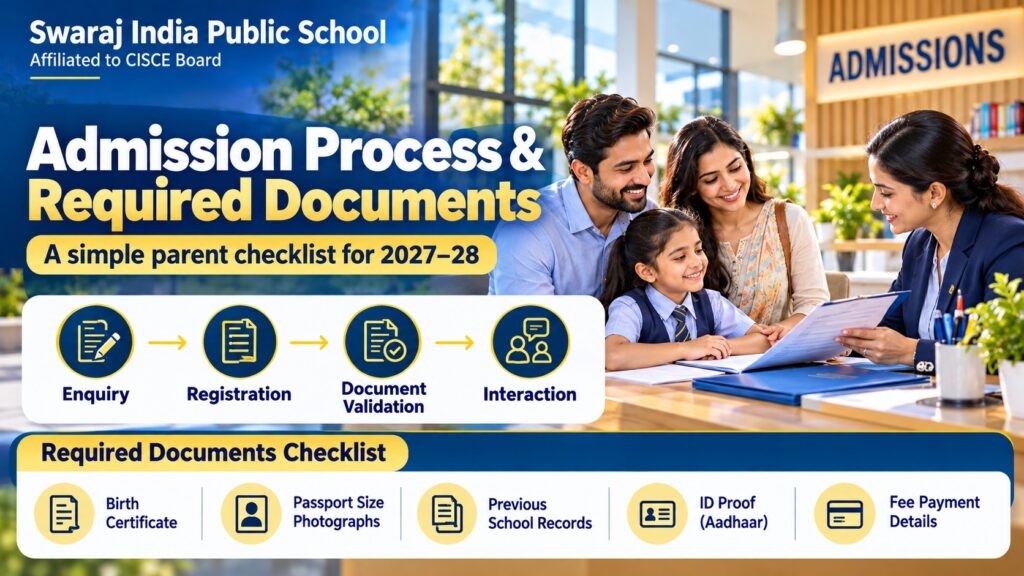
How the Current SIPS Admission Process Works
Swaraj India Public School currently publishes a structured admission process.
Parents planning for 2027–28 can use the present process to understand the general sequence, but should reconfirm final requirements once the new session opens.
| Current Step | What Happens |
|---|---|
| Initial enquiry | Classes 1–5 may enquire online/in person; Class 6 onward requires a campus visit |
| School tour | Available by appointment |
| Registration | Initial registration completed |
| Application form | Application link shared |
| Document submission | Required records and photographs uploaded |
| In-person validation | One parent visits for document/form verification |
| Entrance & interaction | Child and parent attend where applicable |
| Result & fee details | Shared through administration |
| Confirmation | Admission confirmed after required fee process |
Initial Enquiry
For Classes 1–5, the current system allows an initial enquiry online or in person where applicable.
For Class 6 onwards, the school currently asks parents to visit the campus and bring the student’s latest report card before moving further.
This gives the admissions team academic context before the process continues.
Campus Tour
The current process allows families to schedule a school tour by appointment.
Parents should use this opportunity.
A tour gives you time to understand the school environment instead of seeing only the admission office.
Registration and Application
After initial enquiry, parents proceed with registration and the application process.
Because registration charges and procedures may change for a future session, parents should verify all 2027–28 amounts directly rather than relying on an older figure.
Document Validation
The current process includes in-person document and application validation.
This is a useful opportunity for parents to clarify any remaining questions.
Entrance and Interaction
Where applicable, the child and parent attend the relevant interaction.
Parents should not assume that every class has exactly the same assessment format.
Ask what will be expected for the particular class.
Documents Parents Can Prepare in Advance
Preparing documents early saves unnecessary stress once admission begins.
The current SIPS process lists several records that parents should be prepared to provide.
| Document | Why It May Be Required |
|---|---|
| Child’s photograph | Student identification |
| Parent photographs | Parent/guardian records |
| Birth certificate | Age verification |
| Latest report card | Academic background |
| Aadhaar card | Identity/documentation requirement |
| Transfer certificate | Usually relevant when moving schools |
| Address information | School records/communication |
| Contact details | Parent communication/emergency use |
Parents should confirm the exact final list for 2027–28.
Sensitive identity documents should only be submitted through the school’s official process.
Entrance Tests and Parent-Child Interaction
The words “entrance” and “interaction” can make parents and students unnecessarily nervous.
The best approach is to understand the purpose.
For a school, an interaction can help answer several questions.
What has the child studied previously?
Is the student comfortable with the level expected for the new class?
Are there areas where additional support might be necessary?
How does the child communicate?
Does the family understand the school’s academic expectations?
Parents can prepare without turning the process into excessive coaching.
For Younger Children
Focus on comfort and basic academic foundations.
A child should feel comfortable speaking about school, interests and previous learning.
For Middle-School Students
Revision of major concepts from the previous class can help.
More importantly, students should be able to explain how they approach a question rather than only memorise answers.
Parent Interaction
Parents should also be ready to discuss:
- previous schooling;
- reasons for changing school;
- academic concerns;
- interests;
- any learning-support needs;
- and expectations from the new school.
Transparency is more useful than trying to present a “perfect” child.
How to Evaluate Academics During a School Visit
A school may describe itself as academically strong.
Parents should ask what that means in practice.
Ask About Teaching Method
A useful question is:
“What happens after a teacher explains a concept?”
Do students solve problems?
Discuss?
Experiment?
Present?
Research?
Apply the concept through projects?
The answer can reveal whether teaching is passive or active.
Ask About Academic Support
No school has only high-performing students.
What matters is what happens when a child struggles.
SIPS currently publishes information about academic improvement classes designed to help students strengthen concepts and confidence.
Parents should ask:
- Who attends these classes?
- How are children identified?
- How often are they conducted?
- How is progress monitored?
Ask About Assessment
Parents should understand whether assessment is used only for marks or also for feedback.
A strong system should help identify learning gaps early.
Teacher Experience and Individual Attention
Parents often spend more time evaluating the campus than the teaching team.
The order should probably be reversed.
A school can purchase new infrastructure quickly.
Building a stable, experienced teaching culture takes much longer.
Swaraj India Public School currently reports 12+ years of average teacher experience and a 22:1 student-to-teacher ratio.
These figures are useful starting points, but parents should still ask how they translate into everyday learning.
Questions to Ask About Teachers
- What is the normal class strength?
- How long do teachers typically remain with the school?
- Are subject teachers available for questions?
- How are new teachers trained?
- How are teaching standards monitored?
- How are struggling students supported?
Individual attention does not mean a teacher works with one child all day.
It means teachers know when a student is confused, disengaged, improving or falling behind.
Student Support Beyond Marks
Students do not leave personal challenges at the school gate.
Academic performance can be affected by:
- confidence;
- friendships;
- stress;
- exam anxiety;
- poor time management;
- family changes;
- and uncertainty about the future.
Swaraj India Public School currently operates its C-Cube Career & Counselling Cell, which supports students with academic, emotional and time-management challenges.
For parents, the existence of a counselling system is useful, but understanding how it functions is even more important.
Ask:
- Can students approach counsellors directly?
- How are concerns identified?
- When are parents involved?
- Is counselling preventive as well as reactive?
- Is career guidance provided as students grow older?
Learning Beyond Textbooks
Parents often say they want “holistic development”, but that phrase becomes meaningful only when schools explain what children actually do.
SIPS currently publishes several structured learning initiatives.
Project-Based Learning
Project work can help students connect different subjects, collaborate and solve practical problems.
The value depends on how much thinking the student does.
A project completed entirely by parents at home has little educational value.
Bagless Project Periods
SIPS currently describes bagless project periods for primary students, using activities, audiovisual learning, field visits and teacher-designed material.
This kind of approach can make learning more experiential when executed well.
Vocabulary Enhancement
The school also publishes a vocabulary programme for Classes 1–12 in which students are introduced to new words regularly.
Language development becomes increasingly important as academic texts grow more complex.
Value Education
SIPS describes daily value-education discussions around ethics, awareness and broader life ideas.
Parents interested in values-based schooling can ask how these sessions are adapted for different age groups.
Sports and Physical Development
A school should not force parents to choose between academics and physical activity.
Children need movement.
Sports can help develop:
- discipline;
- fitness;
- teamwork;
- resilience;
- focus;
- leadership;
- and the ability to handle both success and failure.
Swaraj India Public School operates a structured sports programme through the Swaraj India Sports Academy.
The school currently lists disciplines including basketball, badminton, lawn tennis, skating, cricket, football, chess, aerobics, table tennis, archery and karate.
However, parents should always ask a second question:
How frequently does the average student actually participate?
Facilities alone do not create sporting development.
Regular access, coaching, participation and feedback matter more.
Co-Curricular Participation
Another useful SIPS feature is its published 100% Participation Policy.
The school states that every child participates in annual sports, science, literary and cultural events.
This matters because school activities are often dominated by the same confident students.
Broad participation gives quieter students opportunities to try something new.
A child may discover an interest in:
- debate;
- music;
- drama;
- public speaking;
- science;
- art;
- athletics;
- or leadership
only after being encouraged to participate.
Leadership Development
Leadership should not be limited to giving a few students badges.
The meaningful part is responsibility.
SIPS currently publishes information about its Student Government Body, through which students take on roles such as school captains, house leaders, marshals and literary, cultural and sports positions.
Parents can ask what responsibilities these students actually hold.
The best leadership programmes give students real opportunities to organise, communicate and solve problems.
Educational Tours and Real-World Exposure
Classroom learning becomes stronger when children can connect concepts with real places and experiences.
SIPS currently describes structured educational tours for middle and senior students.
Parents should ask:
- how frequently trips occur;
- how destinations are selected;
- whether activities connect with academic learning;
- and what supervision systems are used.
Educational exposure should be purposeful, not simply recreational.
Achievements: How Parents Should Read Them
Awards and competition results can tell parents something about a school’s culture, but they should be interpreted carefully.
Swaraj India Public School publishes a long record of student achievements in areas including debate, quiz, cultural events and national-level competitions.
It also highlights participation and recognition through platforms such as the World Scholar’s Cup.
These are useful signals of opportunity and exposure.
However, parents should ask:
How broad is participation?
If achievements involve only a tiny percentage of students, the experience may not represent normal school life.
That is why achievements should be considered alongside the school’s broader participation systems.
What to Check During a Campus Visit
A school visit should be planned like an inspection, not a sightseeing tour.
Parents can use the following framework.
| Area | What to Observe | What to Ask |
|---|---|---|
| Classrooms | Organisation, student comfort | Typical class size |
| Teachers | Interaction with students | Academic support |
| Laboratories | Equipment and use | Frequency of practical work |
| Library | Accessibility and resources | Reading programmes |
| Sports | Actual activity | Coaching and participation |
| Counselling | Visible support system | How students access help |
| Washrooms | Hygiene | Maintenance process |
| Entry/exit | Security and organisation | Visitor/pickup procedure |
| Administration | Clarity and responsiveness | Communication system |
Classrooms
Do not judge a classroom only by decoration.
Look at whether students appear engaged and whether the environment supports learning.
Laboratories
Ask how often students use labs.
A well-equipped laboratory that remains locked most of the week adds little value.
Library
Ask whether children borrow books.
A library becomes meaningful when it is part of student life.
Sports Areas
Try to understand whether facilities are used regularly and whether coaching is structured.
Student Interaction
Observe how students speak to adults.
Do they appear fearful?
Comfortable?
Respectful?
School culture often becomes visible in small interactions.
A 30-Minute Campus Visit Framework
Parents can divide a visit into six short stages.
First Five Minutes: Overall Environment
Notice organisation, cleanliness, movement and staff behaviour.
Minutes 5–10: Students
Observe whether students appear engaged and comfortable.
Minutes 10–15: Teachers
Watch teacher-student communication where possible.
Minutes 15–20: Learning Spaces
Classrooms, labs, library and activity spaces.
Minutes 20–25: Practical Systems
Safety, transport, washrooms, entry and communication.
Final Five Minutes: Direct Questions
Use your prepared checklist.
Do not leave with unanswered questions simply because the tour is ending.
School Safety and Student Wellbeing
Safety is not limited to security guards and CCTV.
Parents should understand the full system.
Ask about:
- controlled entry;
- visitor access;
- authorised pickup;
- transport procedures;
- medical response;
- supervision;
- fire and emergency systems;
- bullying response;
- and counselling support.
Emotional safety matters as much as physical safety.
Students should be able to ask for help without fear of embarrassment.
Parent-School Communication
Communication becomes important when things are going well and essential when they are not.
Parents should ask:
- How are academic reports shared?
- How often are parent-teacher meetings held?
- What happens when performance drops?
- How does the school communicate attendance concerns?
- Can parents contact subject teachers?
- Who handles administrative questions?
- How are urgent issues escalated?
A school with a clear communication system saves parents and teachers from unnecessary confusion.
Understanding School Fees Properly
Fee comparison is often more difficult than it looks.
One school may quote a single composite amount.
Another may separate several charges.
Parents should compare the total likely cost, not only the headline fee.
Fee Comparison Checklist
| Cost Area | Questions to Ask |
|---|---|
| Tuition/composite fee | Is it annual or quarterly? |
| Registration | Is it refundable? |
| Admission charge | One-time or recurring? |
| Examination fee | Included or separate? |
| Activities | Included or optional? |
| Transport | Route-wise cost? |
| Books | School supplied or external? |
| Uniform | Separate vendor/cost? |
| Trips | Optional or compulsory? |
| Competitions | Any additional participation charges? |
SIPS currently states that the Composite Annual Fee is payable quarterly and that examination fees and some optional activities may be charged separately.
Parents should request the complete 2027–28 class-specific fee schedule once available.
Why Fee Transparency Matters
The lowest fee does not automatically represent the best value.
The highest fee does not automatically represent the best education.
Parents should understand what they are paying for.
A useful comparison considers:
- academic quality;
- teacher stability;
- student support;
- facilities;
- sports;
- activities;
- location;
- and additional charges.
The goal is not simply to identify a cheaper or more expensive school.
It is to understand whether the overall proposition makes sense for your family.
Location: Why Kakadeo Matters for Local Families
Parents often underestimate the impact of daily travel.
A commute that looks manageable on Google Maps at midday may feel very different during school traffic.
For a child, extra travel can reduce:
- sleep;
- homework time;
- physical activity;
- relaxation;
- and family time.
Swaraj India Public School is located at:
117/M/8 (M-Block), Kakadeo, Kanpur – 208019, Uttar Pradesh
Families around Kakadeo and nearby parts of Kanpur can evaluate the school partly through this practical local advantage.
However, location should be one factor rather than the only factor.
An ICSE school in Kakadeo should still be evaluated for academics, teachers, student support and school culture just like any other shortlisted school.
What Does “Best ICSE School in Kanpur” Really Mean?
Parents naturally use the word “best”.
Search engines use it too because people search for it.
But education does not work like buying the fastest laptop or the cheapest airline ticket.
There is no single metric that defines the best school for every child.
A useful definition is:
The best school is the one that matches the child’s academic needs, personality, family priorities and long-term development most effectively.
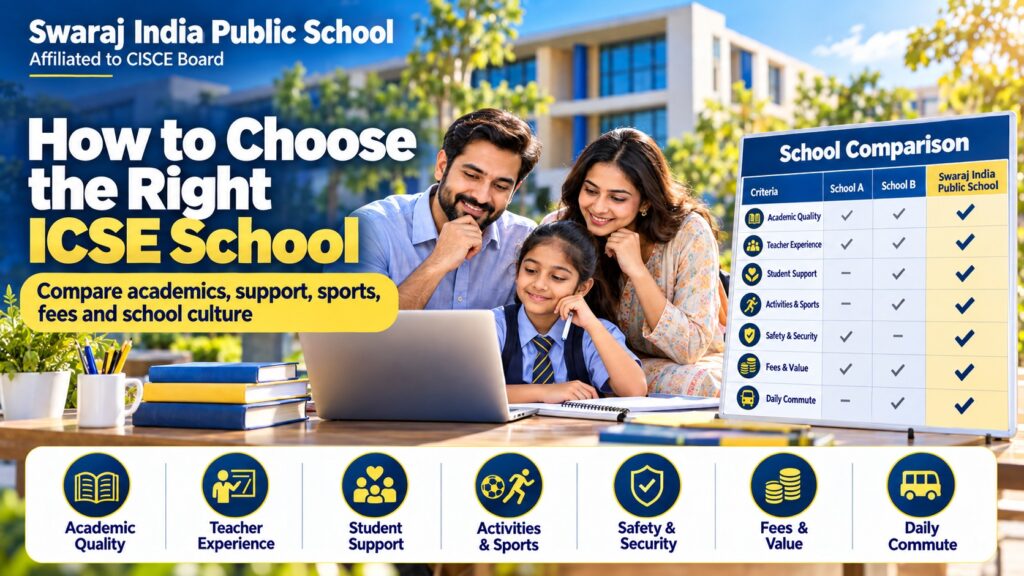
To make that idea practical, parents can score schools using the same criteria.
Parent School-Selection Scorecard
Give each shortlisted school a score from 1 to 5.
| Evaluation Area | Score |
|---|---|
| Academic approach | /5 |
| Teacher experience | /5 |
| Class size/attention | /5 |
| Language development | /5 |
| Academic support | /5 |
| Counselling | /5 |
| Sports | /5 |
| Activities | /5 |
| Leadership opportunities | /5 |
| Discipline/culture | /5 |
| Safety | /5 |
| Parent communication | /5 |
| Campus facilities | /5 |
| Location | /5 |
| Fee transparency | /5 |
| Child comfort | /5 |
Maximum Score: 80
Do not use the score as a mathematical guarantee.
Use it to make sure you are evaluating every school using the same criteria.
Red Flags Parents Should Not Ignore
A good school search should include positive factors and warning signs.
Unclear Fee Information
If the admissions team cannot clearly explain charges, ask for written information before proceeding.
Pressure to Decide Immediately
A family should have enough time to understand the decision.
Vague Academic Answers
If every academic question receives only marketing language, ask for practical examples.
Excessive Focus on Rankings
Awards can be positive, but they should not replace discussion about everyday learning.
Poor Communication During Admissions
The admission process often gives parents their first experience of school administration.
Repeated confusion may be worth noting.
Uncomfortable Child Response
Older children should be included in the decision where practical.
If a child is deeply uncomfortable with the environment, understand why.
How Parents Can Prepare a Child for a New School
Changing schools or entering formal school can create anxiety.
Parents can make the transition easier without creating pressure.
Speak Positively but Realistically
Avoid promising that everything will be perfect.
Instead explain that new teachers, classmates and routines take time to understand.
Visit the Campus Together
Where possible, allow the child to see the environment before the first day.
Restore Academic Routine
If the child has had a long holiday, gradually return to regular reading and study times.
Discuss Concerns
Older children may worry about friendships, teachers or academic difficulty.
Let them express those concerns.
Avoid Comparison
Statements such as “Everyone else manages” usually increase anxiety rather than helping.
Why SIPS May Enter a Parent’s Shortlist
Parents should make their own final decision, but Swaraj India Public School currently publishes several features worth investigating during the shortlisting process.
The school has operated since 1998 and reports:
- 28+ years of educational experience;
- 100+ national and international wins since 2004;
- 12+ years average teacher experience;
- and a 22:1 student-to-teacher ratio.
The school also publishes structured initiatives around:
- academic improvement;
- counselling;
- project-based learning;
- vocabulary development;
- student leadership;
- sports;
- cultural participation;
- educational tours;
- and value education.
These are useful signals because they allow parents to ask specific questions rather than relying on a generic “holistic education” claim.
For example:
Instead of asking, “Do you support weak students?”
ask:
“How do Academic Improvement Classes work?”
Instead of asking, “Do students get counselling?”
ask:
“How can a student access the C-Cube counsellor?”
Instead of asking, “Do children participate in activities?”
ask:
“How does the 100% Participation Policy work in practice?”
Specific questions produce more useful answers.
Parent Questions to Take to the Admissions Office
The following list can be saved before your visit.
Academic Questions
- What is the typical class strength?
- How is reading developed in primary classes?
- How are students supported in mathematics and science?
- How are learning gaps identified?
- What assessment system is used?
- How much homework is expected at my child’s level?
- Are additional academic-support classes available?
Teacher Questions
- How experienced is the teaching team?
- How long do subject teachers generally remain with the school?
- How can students approach a teacher if they need additional help?
Student-Support Questions
- How does counselling work?
- Can students approach counsellors directly?
- What happens if a child’s performance suddenly falls?
- How are parents informed about concerns?
Activity Questions
- How frequently do students participate in sports?
- Are activities available to all students?
- What leadership opportunities exist?
- Are educational tours organised for my child’s age group?
Admission Questions
- Is a seat available in the required class?
- What is the 2027–28 admission timeline?
- What documents are required?
- Is there an entrance assessment?
- Who needs to attend the admission interaction?
Practical Questions
- What are school timings?
- What transport options are available?
- What is the complete fee structure?
- Which charges are separate?
- How does parent-school communication work?
Swaraj India Public School Contact Information
Families exploring ICSE school admission in Kanpur can contact the school directly for the latest admission information.
Swaraj India Public School
117/M/8 (M-Block), Kakadeo
Kanpur – 208019
Uttar Pradesh, India
Phone:
+91-512-2500309
+91-512-2504442
Email:
info@sipsknp.com
Office Hours:
Monday to Saturday
9:00 AM – 3:00 PM
Parents planning admission for 2027–28 should ask specifically about:
- class availability;
- official admission opening dates;
- current age criteria;
- applicable fees;
- interaction/entrance process;
- and required documents.
Frequently Asked Questions About ICSE School Admission in Kanpur 2027–28
When should parents start researching schools for 2027–28?
Parents can begin several months before the academic session. Early research gives families enough time to shortlist schools, schedule visits, prepare documents and understand the admission process.
Is Swaraj India Public School accepting 2027–28 admissions right now?
The school’s current online admission and fee information still references the existing cycle. Parents planning for 2027–28 should contact the school directly to confirm when the new admission process officially opens.
What documents are currently required for SIPS admission?
The current process includes photographs of the child and parents, a birth certificate, latest report card and Aadhaar card. Final requirements for 2027–28 should be confirmed with the admissions office.
Can parents apply online for Classes 1–5?
The current process allows Classes 1–5 to begin with an online or in-person enquiry where applicable.
What happens for admission to Class 6 or above?
The current process requires a campus visit for Class 6 onwards and asks parents to provide the child’s latest report card before proceeding further.
Is there an entrance test at Swaraj India Public School?
The published admission process includes an entrance and interaction stage where applicable. The exact class-specific format should be confirmed directly with the school.
Should parents visit the school before admission?
Yes. A campus visit gives families a much better understanding of classrooms, learning spaces, teacher-student interaction, safety and overall culture.
How should I choose the best ICSE school in Kanpur?
Use the same comparison framework for every school. Evaluate academics, teachers, student support, counselling, sports, activities, discipline, communication, location, safety and fees.
Is the school closest to home always the best choice?
Not necessarily. Location matters because of daily travel, but it should be balanced with academic quality, school culture and student support.
What is SIPS’s student-to-teacher ratio?
The school currently publishes a student-to-teacher ratio of 22:1.
How experienced are teachers at SIPS?
SIPS currently reports more than 12 years of average teacher experience.
Does SIPS provide extra academic support?
The school publishes information about Academic Improvement Classes designed to help students strengthen foundational concepts and confidence.
Does Swaraj India Public School provide counselling?
Yes. The school currently operates the C-Cube Career & Counselling Cell to support academic, emotional and time-management needs.
Does every student get opportunities in activities?
SIPS publishes a 100% Participation Policy under which students participate in annual sports, science, literary and cultural activities.
What sports are available at SIPS?
The school’s sports programme currently includes multiple disciplines such as basketball, badminton, lawn tennis, skating, cricket, football, chess, aerobics, table tennis, archery and karate.
Does the school provide leadership opportunities?
SIPS runs a Student Government Body through which students take on various school, house, sports, literary and cultural responsibilities.
Are educational tours available?
The school publishes information about structured educational and outstation tours, particularly for middle and senior students.
How are fees paid?
The current school fee information describes quarterly payment of the Composite Annual Fee through authorised channels. Parents should obtain the applicable 2027–28 fee schedule before admission.
Are examination fees included in the main fee?
Under the current published structure, examination fees are charged separately. Parents should reconfirm the position for the new session.
Where is Swaraj India Public School located?
The school is located at 117/M/8 (M-Block), Kakadeo, Kanpur – 208019, Uttar Pradesh.
How can I contact SIPS for admission?
Parents can call +91-512-2500309 or +91-512-2504442, or email info@sipsknp.com.
Final Thoughts
Parents searching for the best ICSE school in Kanpur are ultimately looking for confidence.
They want confidence that their child will learn properly.
Confidence that teachers will notice when support is needed.
Confidence that discipline will develop responsibility rather than fear.
Confidence that sports and activities will be meaningful rather than decorative.
Confidence that communication will remain clear after the admission fee has been paid.
And confidence that the school their child attends every day will help them become steadily more capable, independent and mature.
Those questions cannot be answered by a search ranking alone.
Google can help you discover schools.
A directory can help you create a shortlist.
A website can help you understand programmes and facilities.
But parents should make the final choice after speaking with the school, visiting the campus and comparing options using the same practical criteria.
For families preparing for ICSE school admission in Kanpur for the 2027–28 academic session, begin early enough to make the decision without pressure.
Understand what your child needs.
Research the school properly.
Review the academic approach.
Ask about teachers.
Understand student support.
Explore sports and activities.
Visit the campus.
Check the commute.
Request complete fee information.
Ask about the actual admission process.
And give your child a voice in the decision where age allows.
The best school is not automatically the school that makes the biggest claim.
It is the school where strong academic foundations, thoughtful guidance, disciplined learning and meaningful opportunities come together in a way that suits the child.
Parents considering Swaraj India Public School in Kakadeo, Kanpur can contact the admissions team, schedule a campus visit and discuss the appropriate class and admission process for the 2027–28 academic session.
Swaraj India Public School
117/M/8 (M-Block), Kakadeo, Kanpur – 208019
Phone: +91-512-2500309 / +91-512-2504442
Email: info@sipsknp.com